How can social robots help in following a personalized meal plan
Course: Qualitative Research Methods + Participatory Design
Program: MSC in Human-Computer Interaction
Duration: 5 Months
Introduction
When our team started thinking about how a social robot could help people stick to a meal plan, we realized how common this struggle really is. For students especially, keeping up with a healthy diet or any structured meal plan can feel like an uphill battle. With so many other things to focus on, like attending classes, working on assignments, and balancing personal responsibilities, it’s easy to see why meal planning often gets pushed aside. Even for those who try, sticking to a meal plan isn’t always easy. Unexpected things, like a busy day, running out of ingredients, or even just feeling too tired to cook, can make it hard to follow through.
Research methodology
Thinking about these challenges, we wanted to dig deeper into why meal planning feels so difficult and what could actually make it easier. We decided to break our research into four parts: observations, interviews, a focus group, and a workshop, to make sure we explored this problem from different perspectives. Each step gave us new insights into what people face every day when it comes to planning and preparing their meals.
Observations
We went to different supermarkets and university cafes spread across Trento, Rovereto, and Povo areas and observed what people ate for lunch and dinner and what choices they made and what influenced their choices. An online observation was also conducted through different forums on Reddit to understand how students made their meal plan and if they followed their dietary goals consistently. From the observations, we understood that international students had a harder time understanding the nutritional info and in making a choice. We also spotted that when students ate in groups, their choices were more nutritional, compared to when they ate solo.
Interviews
We conducted 8 interviews to further understand how meal planning was performed among diverse student population. Our participants were in the age range of 20 - 28 and varied from nationalities including Turkish, Indonesian, Italian, Spanish, and Chinese. After we analysed the results, we learnt that students strongly prefer flexible, low-effort meal guidance over rigid daily diets. Decision-making is primarily driven by time constraints, limited grocery budgets, and a desire to minimize food waste, often leading to instant meals or batch cooking. While participants frequently use traditional family recipes or platforms like TikTok and ChatGPT for inspiration, they express distrust in generic AI accuracy, complex prompts, and data privacy issues. To effectively support these users, a social robot must provide low-friction, pantry-based recipe recommendations that account for available prep time, budget limits, and cultural preferences. Additionally, integrating transparent nutritional breakdowns and light, gamified reward systems can help users maintain balanced eating habits without causing decision fatigue.
Focus Group
To evaluate the feasibility, trust factors, and functional expectations of AI-driven meal planning and social robotics, our team conducted a focus group with 8 participants, lasting around 45 to 60 minutes. During the session, we asked participants about their personal experiences with meal planning, their willingness to trust AI recommendations over human nutritionists, and how hypothetical smart tools could better motivate healthy habits.
Through the discussion, we identified a core tension between strict nutritional discipline and practical daily flexibility. Participants emphasized that overly rigid meal plans trigger psychological burnout, leading to low compliance. While participants saw potential in AI for real-time adjustments and quick recipe substitutions, trust remains a major hurdle. Most participants preferred human nutritionists for their empathy and accountability, while raising concerns about AI accuracy and data privacy.
To address these hurdles, participants suggested using highly visual, friction-free interfaces—such as photo-based meal suggestions instead of dense text—and proposed light gamification strategies to make dietary tracking feel less like an obligation. Ultimately, the group highlighted that a social robot needs to move past generic meal planning, offering real-time, adaptive guidance that respects individual preferences, time constraints, and actual cooking habits.
Workshop
To translate theoretical user insights into concrete system requirements, our team facilitated a 2-hour Participatory Design workshop with 10 participants in Trento. The session brought together a diverse group across demographics (70% female, 30% male; ages 18–44) and occupations, Master's/PhD students, post-docs, and working professionals across seven countries of origin (including the USA, Netherlands, Poland, Ecuador, India, Palestine, and Spain). Over four structured activities—including a Physical Kahoot icebreaker, a goal-constrained meal plan creation exercise, persona-based brainstorming, and low-fidelity prototyping using materials like Play-Doh and crafting supplies—participants worked in small teams to identify meal compliance friction points and design tangible social robot interventions.
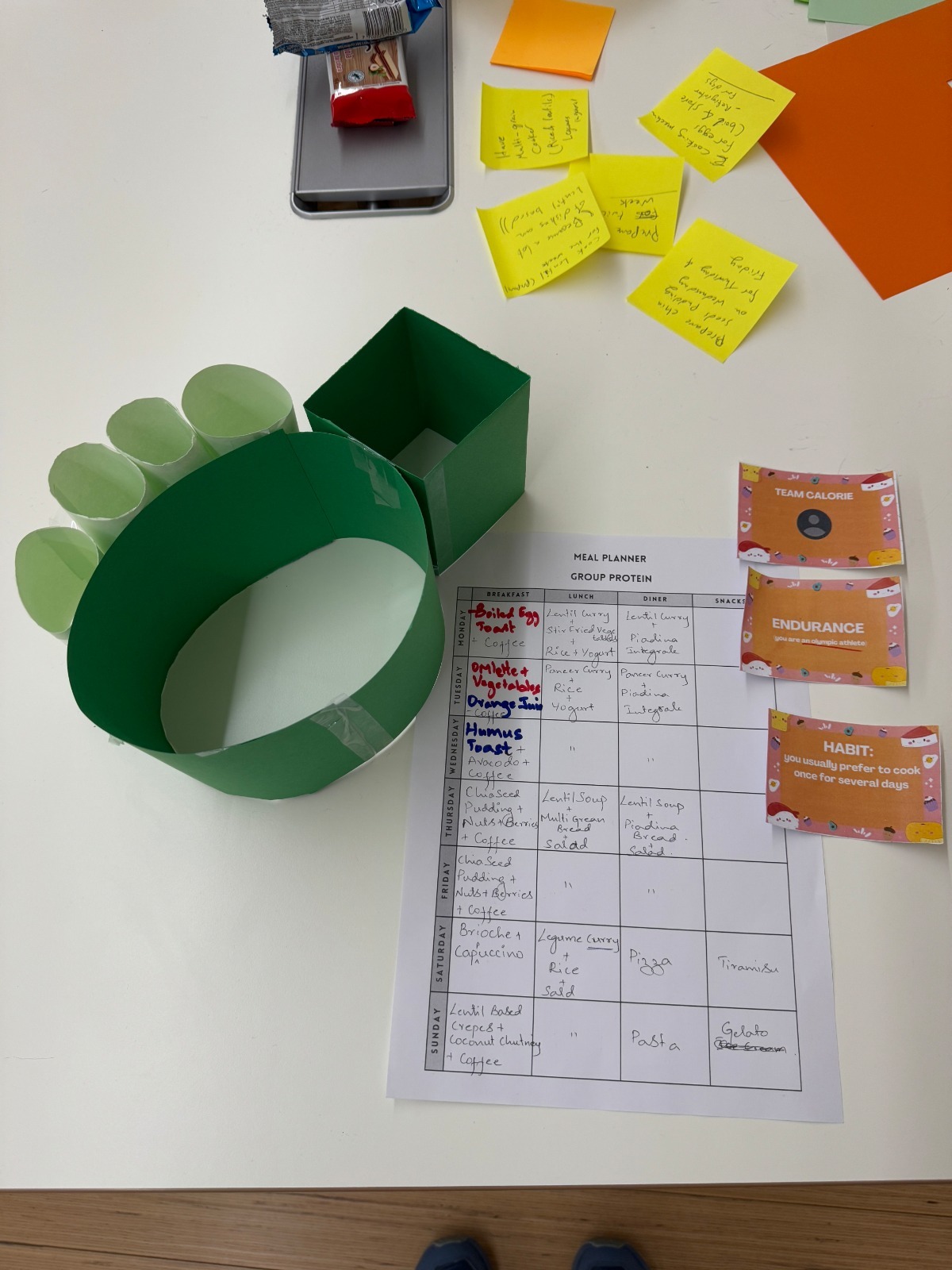
Through the physical prototypes and collaborative presentations, we identified several core outcomes for social robotic design in nutrition. Participants strongly rejected rigid daily schedules, favoring adaptive robots that dynamically modify recipe suggestions based on time constraints, fatigue, and current fridge inventory. The prototypes emphasized multimodal, low-friction interactions—such as built-in cameras for ingredient scanning, visual projections, and voice feedback—to eliminate the hassle of manual phone input. Ultimately, the workshop highlighted that a social robot must act as a supportive, empathetic companion, leveraging light gamification and visual encouragement rather than strict, judgmental oversight.