Paypath: An app built to withdraw money from ATMs for people with limited vision
Course: Basics of Impact Innovation and Entrepreneurship.
Program: Erasmus exchange, University of Twente.
Duration: 2 and-a-half months
Introduction
For millions of people with blindness, ATMs are one of the friction points in withdrawing cash. While countries have been pushing to digitalize payment systems through NFC-based payments, they are preferred less in countries with high cash usage. While many ATMs claim to be accessible, several of them have broken headphone jacks, absence of screen readers, and are sometimes located in noisy areas. In my experience, I have come across only a handful of ATMs that were accessible for a person with blindness across India, Italy, and the Netherlands. On top of the hurdles I mentioned before, some ATMs also lack the braille labels for ATM card slots, have no tactile buttons for the keypad, or use a touch-based interface.
Considering the problems mentioned above, our team came up with an app service, which would work as a B2B service for Banks. The app acts as an interface between the ATM and the user. The app would be able to connect via a secure Wi-Fi connection to the ATM, and provide options to withdraw cash, change the ATM PIN, etc. right on a user's smartphone. The prototype also shows the ATMs that support the app's functionality for the locality of the user.
Research
To understand the problem, I recruited 6 participants with blindness from the network of people with blindness. We interviewed 6 people with blindness from Italy, The Netherlands, and India. Through the interviews, we understood that people had significant issues withdrawing cash from ATMs. In the cases where the ATMs were not accessible, the participants told us that they had to rely on a sighted person to accompany them, hindering their privacy. Furthermore, some ATMs were located in crowded places, leaving the user not able to hear the speech from the ATM machine. The existence of a single language for the screen reader further complicated things for people who recently moved to a new country.
Solution
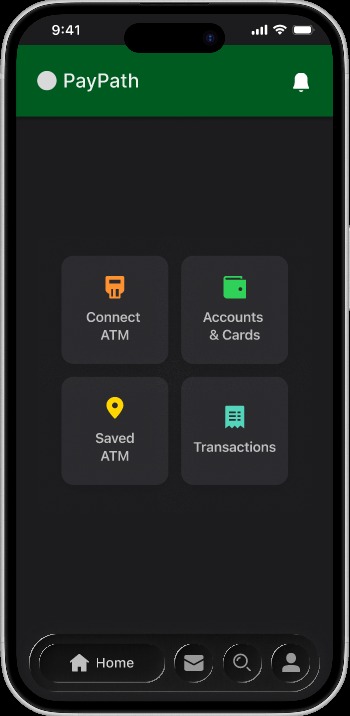
We created a prototype that shows the interface for the app we envisaged. As stated before, this app connects to the ATM machine through a highly secure Wi-Fi connection, and lets the user connect to the ATM machine directly through their smartphone, and then lets them withdraw cash, change ATM PIN, or check the balance present on their account. I thoroughly tested the prototype with several screen readers, including NVDA, Voiceover, JAWS, Narrator, and Orca. I manually tested each and every window for accessibility issues. While we didn't find any issues with the functionality of the app, the interface did face some accessibility hurdles due to the platform where the prototype was built, namely Figma.
After recruiting 3 participants with blindness from my network, we asked them to test the prototype with their screen readers. Two participants were from the Netherlands, and one was from India. The overwhelming consensus was that the concept was really interesting and useful, and with some more improvements to the interface, the solution could solve a real problem faced by people with blindness.
The participants also gave us some more suggestions on improving the prototype and to provide a real-time audio guidance system for them to reach these accessible ATMs present in their city. They also suggested that the app could serve as a cash identifying app, improving the ease of access for people with disabilities.